


Since 2014, World Menstruation Day is celebrated globally on May 28th as part of a campaign to raise awareness about menstrual health and hygiene and to shift negative social norms surrounding menstruation. It is observed on May 28th because women, on average, menstruate for five days each month, with a menstrual cycle lasting 28 days.
Let’s join hands and be a driving force for change to break this culture of silence and create a period-friendly world. As responsible Muslims, we need to educate and generate awareness among our family, friends, relatives, and society at large about the common myths surrounding periods and how to overcome the associated taboos by using the best practices of Islamic teachings about menstruation.
In this article, we will explore:
What do Muslim women, especially in India, go through during their periods?
What does Islam say about menstruation?
How can we overcome the social stigma surrounding a menstruating Muslim woman?
Dos and Don’ts during Menstruation in Islam in Light of Period Shame and Stigma
Muslim Women in India and Period Shame
 Being born and raised in India, I have experienced period shame since my menarche (first period). From puberty, we are taught not to talk about menstruation openly due to the prevailing taboo in our so-called progressive society. Girls can only share their experiences with female family members, and even then, only about the availability and accessibility of period products. The psychological aspects of menstruation are still neglected.
At workplaces, schools, and other educational institutions, the availability, accessibility, and affordability of period products, as well as open discussions about menstruation, remain challenging. Although many initiatives are underway in India, particularly in rural areas, to break these barriers, we still have a long way to go. The ground reality of implementing government projects to end this stigma remains questionable.
As Muslim women, we often consider ourselves impure during menstruation and hesitate to touch anything sacred, such as prayer mats or even general books written in Urdu. We hide in corners to eat during Ramadan due to fear and shame of being noticed by male family members. Menstruating women are not allowed to touch pickles because it is believed that since a woman is impure during her period, the pickle will get spoiled. Elders do not sit on their beds while they are menstruating, and in many families, women are not allowed to cook or enter the kitchen. I have seen people avoid offering namaz (obligatory 5 prayers) in hospitals while they are with a family member during her childbirth because they believe it is an impure place due to postpartum bleeding. Recently, I read a news piece about an adolescent who committed suicide because she could not bear the physiological trauma of her first period, experiencing stress and anxiety.
The situation for marginalized Muslim women is even worse. They often use rags or cloth strips during their periods, which they may wash and reuse due to poverty and lack of availability of clean materials. In some villages, women and girls are using shocking alternatives such as husks and ashes as period pads.
Out of 355 million menstruating girls and women in India, only 12% use sanitary napkins. Nearly 70% of girls are not aware of menstruation before their first period. In villages, over 88% of girls and women resort to using cloth, ashes, and husks during menstruation, leading to urinary tract infections, infertility, and even cervical cancer. 14% of Indian girls suffer from infections due to poor hygiene practices, and 20% drop out of school after reaching puberty because of period shame. 28% of Indian school girls avoid going to school during their periods.
Statistics specific to Muslim women during menstruation are not readily available, but their experiences can be inferred from the broader statistics and cultural influences affecting Indian women.
Breaking the Myths via Islamic Teachings on Periods
Below are the common myths commonly practiced in Indian households. Various authentic hadiths are available to dispel these myths about menstruation. Let’s explore them:
Don’t Touch Prayer Mats!
In many Indian Muslim families, menstruating women and girls are not allowed to touch prayer mats, as they are considered impure during their periods. This impurity is not physical or spiritual but only ritual in Islam. This is evident from the hadith where Aisha (RA) reported: The Messenger of Allah (peace be upon him) said to me: “Get me the mat from the mosque.” I said, “I am menstruating.” He remarked, “Your menstruation is not in your hand.” (Sahih Muslim, Book 3, Hadith 587).
Culture of Disgrace and Isolation
Elders often avoid sharing bedding and utensils with a menstruating woman. In rural India, she is frequently discouraged from participating in social gatherings and barred from entering the kitchen during her menstrual period. To break this myth of untouchability, we can reference hadiths where Aisha (RA) reported: “The Messenger of Allah (peace be upon him) would recline in my lap when I was menstruating, and recite the Qur’an.” (Sahih Muslim, Book 3, Hadith 591). Another hadith states that Aisha (RA) would drink from a vessel while menstruating, and the Prophet Muhammad (peace be upon him) would drink from the same spot (Sahih Muslim, Book of Menstruation, Hadith 298). Additionally, Umm Salama (RA) reported lying with the Prophet (peace be upon him) while she was menstruating (Sahih Muslim, Book 3, Hadith 581).
Don’t Utter the Word “Period” Openly
Muslim adolescent girls bear the consequences of this culture of period silence, unable to openly discuss menstruation, leading to stress, anxiety, and school dropouts. However, in Islam, menstruation was never considered a taboo. Many hadiths suggest that women of Islam used to openly ask the Prophet Muhammad (peace be upon him) about menstruation. For instance, Aisha (RA) reported: “Asma (daughter of Shakal) asked the Apostle of Allah (peace be upon him) about washing after menstruation…” (Sahih Muslim, Book 3, Hadith 649).
Another hadith recounts Fatimah b. Abu Hubaish asking about continuous bleeding, to which the Prophet (peace be upon him) clarified it was a vein and not menstruation (Sahih Muslim, Book 3, Hadith 652).
A Woman Is Impure During Menstruation
Islamic teachings clearly indicate that a menstruating woman is not impure. One hadith mentions that women were allowed to offer salah in clothes with period stains after cleaning them with water (Sahih Muslim, Book 3, Hadith 291). Another hadith reports: “When any of the Prophet’s wives menstruated, he asked her to tie a waist-wrapper and then embraced her” (Sahih Muslim, Book 3, Hadith 577). Additionally, Aisha (RA) mentioned the Prophet (peace be upon him) extending his head from the mosque for her to wash while she was menstruating (Sahih Muslim, Book 3, Hadith 584).
Participation in Hajj
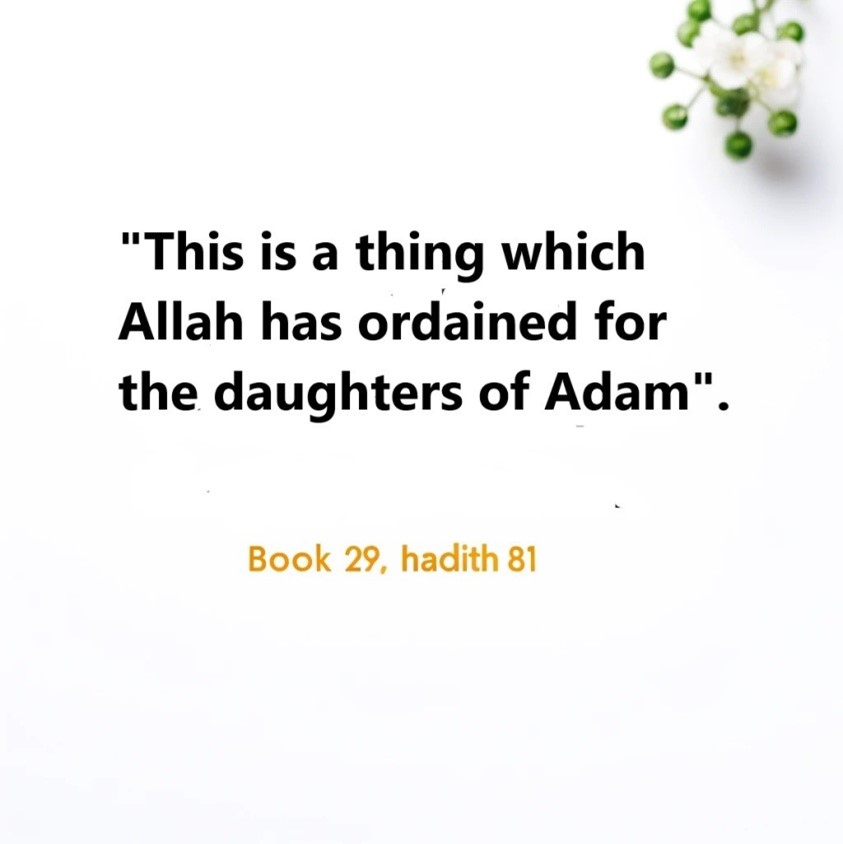
A menstruating woman is allowed to perform all Hajj rituals except Tawaf (circumambulation) around the Kaba. Aisha (RA) said: “We set out with the sole intention of performing Hajj and when we reached Sarif, I got my menses. Allah’s Messenger (peace be upon him) came to me while I was weeping. He said, ‘What is the matter with you? Have you got your menses?’ I replied, ‘Yes.’ He said, ‘This is a thing which Allah has ordained for the daughters of Adam. So do what all the pilgrims do except for the Tawaf around the Kaba.'” (Sahih al-Bukhari, Book 29, Hadith 81).
These hadiths highlight that menstruation is a natural aspect of a woman’s life and provide practical advice for managing religious and everyday activities during her period. The Prophet Muhammad’s (peace be upon him) actions and teachings emphasize treating menstruating women with dignity and normalcy, helping to dispel any social stigma or feelings of shame associated with menstruation.
Educate, Raise Awareness & Empower Muslim Women on Period Shame
In Islam, menstruating women are to be treated with respect, dignity, and normalcy. Our role model, Prophet Muhammad (peace be upon him), never mistreated a menstruating woman. Hadiths clearly indicate that Muslim women should not be considered impure physically or spiritually. For example, the Prophet Muhammad (peace be upon him) showed respect and maintained normal interaction with his wives during their menstruation, indicating no negative stigma should be attached. He would drink from the same vessel as Aisha (may Allah be pleased with her) while she was menstruating (Sahih Muslim, Book 3, Hadith 592).
Menstruation should not prevent women from participating in social, familial, and daily activities. They can engage in normal life activities. For instance, in a hadith, Prophet Muhammad (peace be upon him) instructed Aisha to fetch a mat from the mosque while she was menstruating, indicating her participation in regular tasks (Sahih Muslim, Book 3, Hadith 659).
The respectful treatment of menstruating women by the Prophet Muhammad (peace be upon him) serves as a model for Muslims to follow, breaking any social stigma or period shame. For example, in one hadith, Prophet Muhammad (peace be upon him) would lean on Aisha’s lap and recite the Qur’an while she was menstruating, highlighting a compassionate and normal approach (Sahih al-Bukhari, Book 6, Hadith 298).
Understanding and empathy should be encouraged. Menstruation can sometimes cause discomfort or emotional stress, especially among adolescents, and providing support and care is important during this period.
Dos and Don’ts of Menstruation in Islam in Light of Period Shame and Stigma
Islamic teachings provide clear guidelines on how menstruating women should conduct themselves and how they should be treated, aiming to reduce period shame and stigma.
 Being born and raised in India, I have experienced period shame since my menarche (first period). From puberty, we are taught not to talk about menstruation openly due to the prevailing taboo in our so-called progressive society. Girls can only share their experiences with female family members, and even then, only about the availability and accessibility of period products. The psychological aspects of menstruation are still neglected.
At workplaces, schools, and other educational institutions, the availability, accessibility, and affordability of period products, as well as open discussions about menstruation, remain challenging. Although many initiatives are underway in India, particularly in rural areas, to break these barriers, we still have a long way to go. The ground reality of implementing government projects to end this stigma remains questionable.
As Muslim women, we often consider ourselves impure during menstruation and hesitate to touch anything sacred, such as prayer mats or even general books written in Urdu. We hide in corners to eat during Ramadan due to fear and shame of being noticed by male family members. Menstruating women are not allowed to touch pickles because it is believed that since a woman is impure during her period, the pickle will get spoiled. Elders do not sit on their beds while they are menstruating, and in many families, women are not allowed to cook or enter the kitchen. I have seen people avoid offering namaz (obligatory 5 prayers) in hospitals while they are with a family member during her childbirth because they believe it is an impure place due to postpartum bleeding. Recently, I read a news piece about an adolescent who committed suicide because she could not bear the physiological trauma of her first period, experiencing stress and anxiety.
The situation for marginalized Muslim women is even worse. They often use rags or cloth strips during their periods, which they may wash and reuse due to poverty and lack of availability of clean materials. In some villages, women and girls are using shocking alternatives such as husks and ashes as period pads.
Out of 355 million menstruating girls and women in India, only 12% use sanitary napkins. Nearly 70% of girls are not aware of menstruation before their first period. In villages, over 88% of girls and women resort to using cloth, ashes, and husks during menstruation, leading to urinary tract infections, infertility, and even cervical cancer. 14% of Indian girls suffer from infections due to poor hygiene practices, and 20% drop out of school after reaching puberty because of period shame. 28% of Indian school girls avoid going to school during their periods.
Statistics specific to Muslim women during menstruation are not readily available, but their experiences can be inferred from the broader statistics and cultural influences affecting Indian women.
Breaking the Myths via Islamic Teachings on Periods
Below are the common myths commonly practiced in Indian households. Various authentic hadiths are available to dispel these myths about menstruation. Let’s explore them:
Don’t Touch Prayer Mats!
In many Indian Muslim families, menstruating women and girls are not allowed to touch prayer mats, as they are considered impure during their periods. This impurity is not physical or spiritual but only ritual in Islam. This is evident from the hadith where Aisha (RA) reported: The Messenger of Allah (peace be upon him) said to me: “Get me the mat from the mosque.” I said, “I am menstruating.” He remarked, “Your menstruation is not in your hand.” (Sahih Muslim, Book 3, Hadith 587).
Culture of Disgrace and Isolation
Elders often avoid sharing bedding and utensils with a menstruating woman. In rural India, she is frequently discouraged from participating in social gatherings and barred from entering the kitchen during her menstrual period. To break this myth of untouchability, we can reference hadiths where Aisha (RA) reported: “The Messenger of Allah (peace be upon him) would recline in my lap when I was menstruating, and recite the Qur’an.” (Sahih Muslim, Book 3, Hadith 591). Another hadith states that Aisha (RA) would drink from a vessel while menstruating, and the Prophet Muhammad (peace be upon him) would drink from the same spot (Sahih Muslim, Book of Menstruation, Hadith 298). Additionally, Umm Salama (RA) reported lying with the Prophet (peace be upon him) while she was menstruating (Sahih Muslim, Book 3, Hadith 581).
Don’t Utter the Word “Period” Openly
Muslim adolescent girls bear the consequences of this culture of period silence, unable to openly discuss menstruation, leading to stress, anxiety, and school dropouts. However, in Islam, menstruation was never considered a taboo. Many hadiths suggest that women of Islam used to openly ask the Prophet Muhammad (peace be upon him) about menstruation. For instance, Aisha (RA) reported: “Asma (daughter of Shakal) asked the Apostle of Allah (peace be upon him) about washing after menstruation…” (Sahih Muslim, Book 3, Hadith 649).
Another hadith recounts Fatimah b. Abu Hubaish asking about continuous bleeding, to which the Prophet (peace be upon him) clarified it was a vein and not menstruation (Sahih Muslim, Book 3, Hadith 652).
A Woman Is Impure During Menstruation
Islamic teachings clearly indicate that a menstruating woman is not impure. One hadith mentions that women were allowed to offer salah in clothes with period stains after cleaning them with water (Sahih Muslim, Book 3, Hadith 291). Another hadith reports: “When any of the Prophet’s wives menstruated, he asked her to tie a waist-wrapper and then embraced her” (Sahih Muslim, Book 3, Hadith 577). Additionally, Aisha (RA) mentioned the Prophet (peace be upon him) extending his head from the mosque for her to wash while she was menstruating (Sahih Muslim, Book 3, Hadith 584).
Participation in Hajj
A menstruating woman is allowed to perform all Hajj rituals except Tawaf (circumambulation) around the Kaba. Aisha (RA) said: “We set out with the sole intention of performing Hajj and when we reached Sarif, I got my menses. Allah’s Messenger (peace be upon him) came to me while I was weeping. He said, ‘What is the matter with you? Have you got your menses?’ I replied, ‘Yes.’ He said, ‘This is a thing which Allah has ordained for the daughters of Adam. So do what all the pilgrims do except for the Tawaf around the Kaba.'” (Sahih al-Bukhari, Book 29, Hadith 81).
These hadiths highlight that menstruation is a natural aspect of a woman’s life and provide practical advice for managing religious and everyday activities during her period. The Prophet Muhammad’s (peace be upon him) actions and teachings emphasize treating menstruating women with dignity and normalcy, helping to dispel any social stigma or feelings of shame associated with menstruation.
Educate, Raise Awareness & Empower Muslim Women on Period Shame
In Islam, menstruating women are to be treated with respect, dignity, and normalcy. Our role model, Prophet Muhammad (peace be upon him), never mistreated a menstruating woman. Hadiths clearly indicate that Muslim women should not be considered impure physically or spiritually. For example, the Prophet Muhammad (peace be upon him) showed respect and maintained normal interaction with his wives during their menstruation, indicating no negative stigma should be attached. He would drink from the same vessel as Aisha (may Allah be pleased with her) while she was menstruating (Sahih Muslim, Book 3, Hadith 592).
 Menstruation should not prevent women from participating in social, familial, and daily activities. They can engage in normal life activities. For instance, in a hadith, Prophet Muhammad (peace be upon him) instructed Aisha to fetch a mat from the mosque while she was menstruating, indicating her participation in regular tasks (Sahih Muslim, Book 3, Hadith 659).
The respectful treatment of menstruating women by the Prophet Muhammad (peace be upon him) serves as a model for Muslims to follow, breaking any social stigma or period shame. For example, in one hadith, Prophet Muhammad (peace be upon him) would lean on Aisha’s lap and recite the Qur’an while she was menstruating, highlighting a compassionate and normal approach (Sahih al-Bukhari, Book 6, Hadith 298).
Understanding and empathy should be encouraged. Menstruation can sometimes cause discomfort or emotional stress, especially among adolescents, and providing support and care is important during this period.
Dos and Don’ts of Menstruation in Islam in Light of Period Shame and Stigma
Islamic teachings provide clear guidelines on how menstruating women should conduct themselves and how they should be treated, aiming to reduce period shame and stigma.
Do’s
Treat menstruation as a normal and natural part of life: Engage in regular social and familial interactions without any shame. You can be yourself during your period by cooking, reading, exercising, etc. Maintain personal cleanliness and hygiene: It is normal to take a bath during periods. According to Islamic teachings, women should perform ghusl (full-body ritual purification) after menstruation before resuming prayers. Engage in dhikr (remembrance of Allah) and make supplications (dua): Devote your time to reading religious books and listening to audio/video lectures by scholars. Seek emotional and physical support when needed: Family members should offer support and understanding to a menstruating woman. Open discussions about any discomfort or emotional stress can help break the period silence and provide comfort.Don’ts
Exemption from daily prayers and fasting: Menstruating women are exempt from the five daily prayers (Salah) and fasting during Ramadan. Missed fasts should be made up later, but missed prayers do not need to be made up. Prohibition of sexual relations: Sexual relations are prohibited during menstruation, but other forms of intimacy and affection are allowed. Handling the Qur’an: It is generally advised that menstruating women do not handle the physical Qur’an directly. Digital devices or recitation from memory are permissible. Performing formal prayers in the mosque: Menstruating women should not perform formal prayers inside the mosque, but they can attend classes or lectures if needed. Conclusion Islamic teachings emphasize the normalcy and respect associated with menstruation. The actions and words of the Prophet Muhammad (peace be upon him) illustrate that menstruation should not be a source of shame or stigma. By adhering to these guidelines, Muslims can foster a more supportive and understanding environment for menstruating women. Breaking the silence around menstruation in India requires a multifaceted approach that includes education, government intervention, and grassroots activism. By addressing the cultural and social aspect of period stigma, we can create a more inclusive and supportive environment for all women. It is essential to continue these efforts to ensure that menstruation is seen as a natural and respected part of life, free from any shame and stigma. Thankfully, I am privileged enough to write this piece and share my life experiences about menstruation. However, not everyone in our society has this privilege to share their fears, stress, and anxiety, and many are unable to break the culture of period silence. As a social work professional, I can now challenge period myths, but I was once among those who could not openly discuss menstruation. References:- https://www.menstrualhygieneday.org/
- https://guidestarindia.org/Summary.aspx?CCReg=4948
- https://www.youthkiawaaz.com/2020/06/menstrual-stigma-and-islam-2/
- https://indianexpress.com/article/cities/mumbai/14-year-old-dies-first-period-stress-9235453/
- https://timesofindia.indiatimes.com/life-style/food-news/why-were-women-not-allowed-to-touch-pickles-during-periods/photostory/91814731.cms?picid=91882414
- Sunan al-Nasai, Kitab al-Haid wal-Istihada (The Book on Menstruation and Irregular Bleeding)
- Sunan Ibn Maja, Kitab al-Taharah wa Sunanaha (The Book on Purification and the Prophetic Practice)
- Sahih Muslim, Kitab al-Haid (The Book on Menstruation)
Alima Ahmad (New Delhi)
This content reflects the personal opinions of the author. It is accurate and true to the best of the author’s knowledge and should not be substituted for impartial fact or advice in legal, political, or personal matters.
