


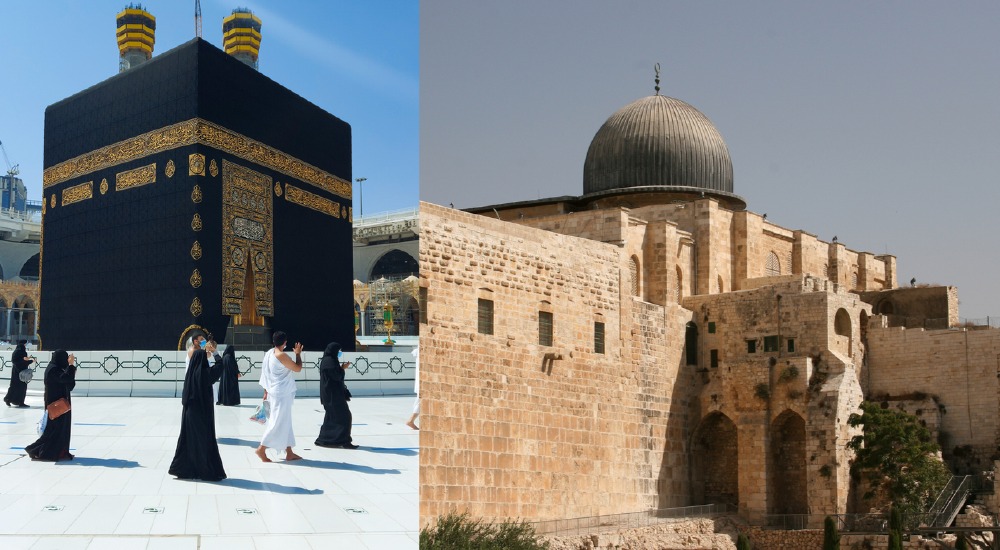
Summary
The article explores the historical connections between the Ka‘bah and Bait Al-Muqaddas, highlighting pilgrimage traditions in Islam and Judaism, shared monotheistic heritage, and the spiritual significance of sacred journeys devoted to Allah.
“Celebrate Hajj Sukkot for seven days after you have harvested the produce of your threshing floor and your winepress. Be joyful at your festival—you, your sons and daughters, your male and female servants, the Levites, the foreigners, the fatherless and the widows who live in your towns.
For seven days celebrate the festival to the Lord your God at the place the Lord will choose. For the Lord your God will bless you in all your harvest and in all the work of your hands, and your joy will be complete. Three times a year all your men must appear before the Lord your God at the place He will choose: at the Hajj of Matzah (Passover), the Hajj of Weeks (Shavuot), and the Hajj of Sukkot. (Bible, Deuteronomy 16:13-16)
The Hajj of Sukkot was chosen by Prophet Solomon to dedicate the First Temple in Jerusalem. (Bible, 1 Kings 8; 2). Hajj Sukkot was so important during the centuries when Solomon’s Temple stood that the holy week of Sukkot was often called simply “the Hajj” (1 Kings 8:3; 8:65; 12:62; 2 Chronicles 5:3; 7:8) because of the very large numbers of Jews who came up to the Temple in Jerusalem, On each of the first six days of Sukkot it was traditional to circle the Temple altar while reciting psalms. On the seventh day of Sukkot the custom was to circle the Temple altar seven times. As the Oral Torah says:“It was customary to make one procession around the altar on each day of Sukkot, and seven on the seventh day.” (Mishnah Sukkah 4:5)
Each circle is done in honor of a prophet; Abraham, Isaac, Jacob, Joseph, Moses, Aaron and David. Muslims will see some similarities and some differences between the Jewish Hajj and the Islamic Hajj. With the destruction of the Second Temple by the Romans in 70 CE, the pilgrimage aspect of the week long harvest festival began a gradual decline in the spiritual consciousness of the Jewish People. Most of the many thousands of Jews from foreign lands outside the Land of Israel and the tens of thousands of Jews from all over the Land of Israel outside the city of Jerusalem, who used to come each year to celebrate the week of Sukkot in Jerusalem at Bait ul-Muqaddas, the Furthest Sanctuary, ceased coming. Two generations later, after a second major Jewish revolt (132-135 CE) in the Land of Israel, the Romans rebuilt Jerusalem as a pagan city filled with idols, That stopped all Jews from coming to the ruined site of the Jerusalem Temple, Bait Al-Muqaddas / Beit HaMiqdash. But even centuries after the destruction of the Temple, and the end of pilgrimage, generations of Jews repeated wonderful tales about pilgrimage experiences in Jerusalem and at the Holy Temple. Crowded as Jerusalem was, there always seemed to be enough room to squeeze everyone in. Indeed, every year it seemed a continuing miracle that pregnant woman didn’t suffer a miscarriage, a rain shower never quenched the fire on the altar, the wind never blew smoke from the fire into the crowds of worshipers, and no one was ever bitten by a scorpion or a snake. Most amazing of all, no one complained, “It is difficult for me to find lodging in Jerusalem.” (Pirkay Avot 5:8) For Muslims, the Furthest Sanctuary is located in Jerusalem.“Glory to Him Who carried His servant by night, from the Holy Sanctuary to the Furthest Sanctuary, the precincts of which We have blessed. so that We might show him some of Our signs. Surely He is the All-Hearing, the All-Seeing. [Sûrah Al-Isrâ’, 17:1]
It is significant that the ruins of the Jerusalem Temple was the site of Prophet Muhammad’s ascension—mi’raj— up to the heavens. The KaCbah built by Abraham and Ishmael —at the site where Abraham had bound Ishmael as an offering— was some centuries later polluted by the introduction of idols. A few centuries later Prophet Solomon built a Temple on the site where Abraham bound Isaac as an offering. Some further centuries later the Temple of Prophet Solomon was destroyed by the Babylonians. It was then rebuilt only to again be destroyed some centuries after that by the Romans—who would later pollute the whole site with a Roman city, filling buildings and streets with idols. One might say that the destruction of the Furthest Sanctuary center of monotheistic pilgrimage in Jerusalem by the pagan Romans, was five and a half centuries afterward overcome by Prophet Muhammad’s ascension—mi’raj up into the heavens— and by the soon to be realized removal by Prophet Muhammad of idols from the paganized KaCbah (Holy Sanctuary) in Makka. For Jews the Temple of Prophet Solomon will be rebuilt only by the Messiah. For Christians Jesus has replaced the need for a special sanctuary for animal offerings. But tens of thousands of Jews and Christians visit Jerusalem every month even without a rebuilt Temple. The Prophet Zechariah envisioned a future time when God helps us to establish worldwide peace. All the nations in the world then may travel to Makka and to Jerusalem to worship God. During Hajj Sukkot, a future Jerusalem will welcome both Jews and non-Jews, even including those who were previously Israel’s enemies:“Then the survivors from all the nations that have attacked Jerusalem, will go up year after year to worship the King, the Lord Almighty, and to celebrate Hajj Sukkot.” (Bible, Zechariah 14:16)
Just as the KaCbah has always welcomed all Muslims who answer the call:“Call upon the people for Hajj. They will come to you on their bare feet, or riding any kind of lean mount, and they come to you from every far-distant pass. [Sûrah Al-Ḥajj, 22:27]
It is only a rare outside observer who can experience even a small fraction of the spiritual feelings of those who engage in a pilgrimage tradition. When peaceful pilgrimage to both Sanctuaries occurs, everyone will see what Mark Twain once wrote about: “It is wonderful, the power of a faith that can make multitudes upon multitudes of old, weak, young and frail enter without hesitation or complaint upon such incredible journeys and endure the resultant miseries without repining.”Frequently Asked Question
Answering the most relevant questions to help you better understand the article.


1 Comment
be blessed