

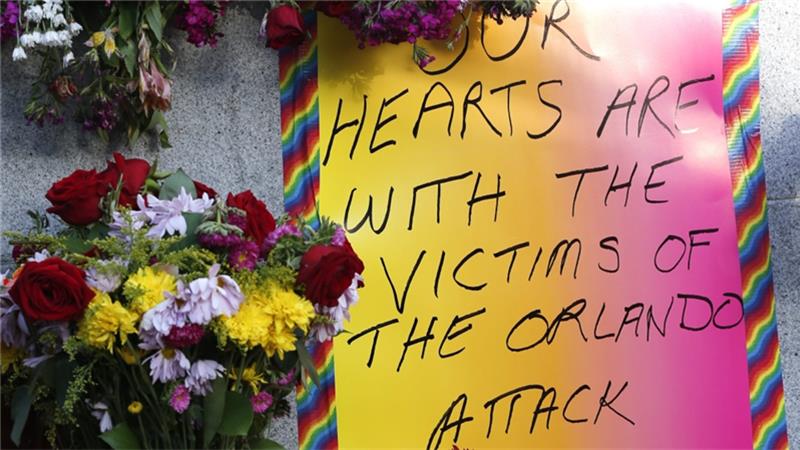
Summary
The article reflects on the Muslim community’s response to the Orlando nightclub massacre, emphasizing compassion for victims, condemnation of violence, and the challenge of balancing Islamic principles with public expectations during times of tragedy.
IT SEEMED THE world was immersed in a pre-Ramadan euphoria, basking in the glow of positive press and supportive words for the North American Muslim community in light of boxer Muhammad Ali’s passing, and the good will he had generated over decades with his larger-than-life personality.
To many, it seemed the rug was pulled out from under them when Muslims had to suddenly return to attack/condemn/why-should-I-have-to-condemn-or-apologize mainstream and social media cycle. To be sure, it is somewhat strange and slightly shortsighted to publicly wring your hands when others are reeling from death and destruction, though I must admit the immediate gut reaction is understandable – I myself am concerned for the safety of my very Muslim looking family.
The details are still coming in about the killer, his motivations, and what really happened at the Pulse bar. What we know for sure is that a gay bar was targeted, 49 are dead from the attack, and 53 were injured. This has led our (read: Muslim community) discussion into numerous directions, tangents, and, understandably, conflicted responses. I offer here my personal thoughts and views on this subject.
Islam’s Stance on Homosexuality
Islam’s stance on homosexuality is no different than any other of the Abrahamic faiths historically, to the point that we share the story of Prophet Lot in our holy scriptures. There has been a marginal attempt by a small group of modern-day pro-LGBTQ academics and activists to obfuscate terminology and give the appearance that Islamic scholarship and thought leaders contain within it significant disagreement and perspectives on homosexual intimate practices (I say practices, meaning the actual act, aside from thoughts). The reality is that across culture and time, they are a fringe minority found mostly in modern-day Western scholarship whose views are driven more by political and career self-interest rather than principled and objective analysis of texts for the purpose of truth-seeking. This leaves us with the overwhelming majority of the community. Our community knows that homosexual relationships are forbidden. At the same time, it is coming to terms with a new and more nuanced understanding of how to deal with homosexuality, separating those who revel and push the lifestyle as something to be accepted and not condemned vs those who hold homosexual desires and inclinations and are fighting such urges. It used to be that both would be lumped into the same category, but scholars have come forward stating the action is sinful, but holding such thoughts are not sinful, and in fact, the person who acknowledges the action is wrong and fights within themselves is actually not just a good person, but perhaps a great person, tested with a most difficult trial by Allah. As we transition to this understanding, our perspectives on how to deal with our brothers and sisters in faith struggling with same-sex attraction problems has taken a turn for the better. We’re learning to be more accepting of them, welcoming them back into the community, and seeing their struggle as our struggle. We’re coming to a place where we let them know we’re there for them, we will never reject them, and that they are one with us. And even for those who have struggled and perhaps even failed to control their nafs –their desires– our Lord is most forgiving of any sin, so long as the person sincerely turns back and repents, and makes an honest effort to get away from their mistake. And if they fail again, Allah knows the effort and the intent.The Muslim Community and the LGBTQ Community
This leaves us with the rest of the LGBTQ community, meaning those who believe there is nothing wrong with their sexual preferences and acting on them. Before I say anything in this discussion, I have to absolutely give credit where credit is due. The LGBTQ community and its activists have been tireless champions for the Muslim community during the Bush era, and they continue to do so. Even after this very recent attack, numerous individuals came forward and declared, “Don’t use my community to further Islamophobia.” I have seen them fight against the abuse of rights perpetrated by law enforcement against individual Muslims, even as the Muslim community themselves abandoned them — and their families — in fear. Without a doubt, I do feel the very human need to reciprocate help with help, to be there for one who has been there for me. The conflict that I have is that the religious law I and most other Muslims live by states that furthering and enabling something that is wrong is itself wrong. Muslims who live by ethics have separated into two groups, generically speaking. One group has taken the view that while we believe homosexuality is morally at odds with our faith, supporting the rights of homosexual marriage is supporting our community as a minority. The other group (which I’m a part of) would say no, in principle this is incorrect and leads to confusion with what we’re supporting and why we’re supporting it. This view is strictly regarding marriage – other issues such as discrimination in the workplace, issues which don’t deal with sexual rights directly, are another matter and I believe we’re all in agreement in standing for those rights. The problem I see in this discussion in putting forward our perspective is that the secular Western value system is incorrectly juxtaposed over the Islamic value system and the terminology and arguments in the former don’t belong in the latter. To be clearer, the secular Western value system would say that two consenting adults should have the right to enjoy whatever sexual relationship they wish and, theoretically, since men and women are equal, just as a man has a right to marry a woman, he has the right to marry a man (since they’re equal), and likewise for women. To hold such values and then selectively apply them would be akin to stating “All men are created equal” and then having laws that treat some differently from others (e.g., slavery). The Islamic legal paradigm does not, to begin with, give two consenting adults, hetero- or homosexual, free reign to enjoy any sexual relationship as they wish. It requires a marriage contract before any type of intimacy can take place. Pre- and extra-marital non-legally recognized relationships come with dire penalties (in theory). The only legally recognized marriage contracts are heterosexual. If you want to stir the pot further, it already has a type of “inequality” built into it that allows a man to have up to four wives, polygyny, but does not permit polyandry. To be clear, our faith does not conceptualize a person’s worth based on their gender or the rights accorded to their gender (or race, or any other unchangeable trait), but rather, according to their religious practice. And that, only God can judge, so if a man thinks he’s superior to a woman, he’s presuming way too much based on the flimsiest of evidences. Allah says in the Quran:O mankind, indeed We have created you from male and female and made you peoples and tribes that you may know one another. Indeed, the most noble of you in the sight of Allah is the most righteous of you. Indeed, Allah is Knowing and Acquainted. [Sûrat Al-Ḥujurât, 49:13]
I say all this to make clear that my lack of support isn’t a question of believing in some right in theory and not taking it to its conclusion in practice. My view is based on what is and isn’t allowed in my faith. Let’s take an example: Assume that we had a new “prohibition” law – sexual prohibition, one in which all people were legally barred from sexual relationships unless they had a legally recognized marriage contract. And, let’s assume a good number of heterosexuals lobbied to have the law repealed (I’m not sure who wouldn’t). The question is, would you find me on the repeal side? The answer is no, and the reason is because I don’t believe in unrestricted sexual relationships, even for heterosexuals. It has nothing to do with discriminating according to a person’s sexuality and everything to do simply with what I believe God has permitted vs not. If an overzealous person of religion ran into a heterosexual club and went on a similar rampage because everyone there is a “sinner” (due to their drinking, dating, etc), I wouldn’t stand with the victims on the basis that I believe in their right to drinking, partying, or open sexual relationships. Nor would I stand with them because of their correct sexual orientation. I would stand with them on the basis that they are fellow human beings, their private lives is their own business. And while I don’t support some aspects of their private lives, I stand firmly against those who would cause death and destruction to others because of their lifestyle choices and their private lives. I would stand with them as fellow human beings who have a right to be left alone to their lives and not targeted for vigilante “justice.” For many, I know this is not enough and it stands on the side of soft or passive discrimination. Social justice students will parse this through the lens of power dynamics, dismiss me as privileged, and likely forget I’m brown and Muslim. I’m ok with that: Intellectual consistency is a rare commodity and challenging dogma isn’t for religion alone. In the end, this is what I, a “conservative” Muslim, can offer back to the community –and I suspect a number who want to find a happy intersection between supporting the LGBTQ community while maintaining their religious sensibilities will feel likewise. You may not agree with our position, but at least try to understand what the conflict is, and realize that not everything is a textbook case of “Either you’re with us or against us.”The Response of Fellow Muslim Activists
I know some Muslim activists will say that they will fight for the rights of all minorities, and will fight for the rights of others, even if they don’t agree with them or the rights they get. I think some of them believe that respecting the law means that the law also has to be defended. The reality is that we’re not required to defend laws we don’t agree with. I don’t agree with pornography: So am I required to defend the rights of pornographers on the basis that it’s a first amendment right, and because I must defend the freedom of speech of others in order to defend my own freedom of religious speech? At a higher level, is it morally defensible to defend morally indefensible laws? The answer is, clearly “No.” Where the law allows us to live our lives as we wish, we do so –and where there is conflict with what we must do or abstain from in a religious sense, we work with our leadership to reconcile. Where the law doesn’t require anything of us, we can stay away. The law doesn’t require us to defend laws we don’t agree with (or any laws, even those we agree with). I don’t support a pornographers First Amendment rights. So how is it virtuous that I must defend that law even as my conscience screams at the depravity of it? The Supreme Court has recently ruled that corporations are people and money in politics is free speech: Do I have to agree with this, or can I oppose it? A second type of Muslim activist has my beliefs, but chooses a calculated approach: Supporting the rights of others when I disagree with them is supporting my own rights. Normally, this comes from a person who doesn’t understand the bigger picture, and it’s this: When leaders take positions, they often don’t get to tack on their politically motivated caveats. Their support is public, and their political machinations are private. Many individuals will look at the statements of these leaders and think their leader actually supports the movement itself. Even if the person clarifies himself in one venue, that clarification will be missed by others. The reason behind the action and the action itself are divorced from one another and the prevailing popular justification, namely, “It’s their right,” becomes the underlying reason by default, normalizing the opinion within the community without properly explaining the “why” of it.Concluding Thoughts
In the end, our thoughts, prayers, and sincere condolences are with the victims in this horrible event and with their families. Our support is for the LGBTQ community as brothers and sisters in humanity, both in this issue and in other rights issues where we can find common ground to support them and where it doesn’t cross into asking us to violate our own religious sensibilities.Frequently Asked Question
Answering the most relevant questions to help you better understand the article.
The article examines how the Orlando tragedy affected Muslim communities, exploring their responses to violence, public scrutiny, compassion for victims, and commitment to Islamic principles during difficult circumstances.
The article encourages Muslims to condemn violence clearly, express compassion for victims, uphold justice, and demonstrate Islamic values through responsible words, sincere concern, and ethical conduct.
The article explains that Muslims faced competing pressures while expressing sympathy for victims, responding to public expectations, and remaining faithful to Islamic beliefs and moral principles.
The article explains that intense media attention often places Muslims under greater scrutiny, requiring thoughtful communication that accurately represents Islamic teachings without compromising religious convictions.
The article encourages showing genuine compassion toward victims and grieving families, recognizing shared human suffering while maintaining dignity, kindness, and sincerity throughout public and personal responses.
The article explains that difficult situations should strengthen commitment to Islamic guidance, ensuring emotional responses remain consistent with justice, mercy, wisdom, and moral responsibility.
The article encourages careful, respectful communication that reflects Islamic ethics, avoids unnecessary hostility, and promotes understanding while remaining truthful about religious beliefs and values.
The article discusses how Muslims may experience pressure to satisfy conflicting public expectations while remaining committed to authentic Islamic teachings and personal religious integrity.
The article presents justice as an essential Islamic principle, encouraging fairness, compassion, and consistent moral standards when responding to violence, suffering, and emotionally charged public events.
The article emphasizes responding to tragedy with compassion, justice, and unwavering commitment to Islamic principles, demonstrating balanced character while navigating complex public and moral challenges.

7 Comments
“Anti Islamophobia” has come to mean “anti gay”.
. Wow. I don’t even know how to process this. I feel sad, angry, and bewildered all at once.
The truth is most people dealing with this disorder in the western world aren’t actually struggling. They happy and proud they’re gay. They establish night clubs to engage in their ungodly activities because they’re country encourages ppl to be gay. Nonetheless, I pray Allah eases the affairs of the ones who are actually striving to come out of it.
It was predictable that the hypocrats and muslim brotherhood operatives or their followers within the ummah will use this incident to subtly compromise our religious stance towards the evil sin of sodomy. No, we will not change our stance towards sodomites, they are not welcome at our mosques and we are free from these evil people.
And of course the author had to mention, that these sodomites are so nice to us and support muslims with regard to civil rights in order to make us feel guilty and repay this supposed support with our support for rights for them and with it a change of our stance towards the satanic act of sodomy in general. The sodomite community does more or less support or it should be rather said they seem to support muslims for purely tactical reasons in order to achieve exactly, what you are trying to do – manipulating us towards accepting sodomy!
And you cannot support their right not to be discriminated at the workplace. In islam there are rights of property, if someone doesn’t want to employ somebody for whatever reason, he has the right to do so. A true muslim employer like any muslim has the muslim duty to be with good muslims, so the last person to employ is a sodomite. Quota regulations and other rules that attack the right of property are socialist and have no place in islam.
Our stance towards sodomites (they are called that and not “gay”, there is nothing gay about sodomy)? Our stance towards them is the same as towards other kuffar in the nonmuslim lands: Their lives, property and honor and other rights are protected. And we do not act against the law. Not more and not less.
That means, that we do not harm the sodomites, but we also don’t show any political support for these people, because it is supporting the act direcly or indirecly, nor do we accept them in our communities.
Jazak Allahu khairan.There is nothing to be added to that. Alhamduillah, in africa those perverts know their place.
In the US those CAIR-leaders even now promote unity with homosexuals and the author should explain what that brotherhood in humanity is and how this includes homosexuals? Would he call Pharao or Ted Bundy or Charles Manson his “brothers in humanity”?
And you can see how he is trying to please kuffar, not only those whom he tenderly calls “lgbt-community”, but also those so called “social justice warriors”. Well, that is the tragedy of being a political activist, which leads to compromizing the deen.
Our job is not to please kuffar or humans, especially not “social justice warriors ” – the most despectable people on earth (truly modern day nazi storm troops or red brigades, people, who truly deserve to be put into the prison at guantanamo bay) – , it is to please our rabb. People like the author should learn the tawhid and what the scholars say about the rectification of the ummah.
You are right, brother, or rather an anglicised version of lootiyun.